Table of Contents
- Quick answer: wallpaper removal cost in a Toronto condo
- What does wallpaper removal cost?
- Why painting over wallpaper almost always fails (and the narrow case where it works)
- The three-step removal method
- What the wall looks like after removal
- Why older Toronto condos are the hardest
- What does not need removal
- Wallpaper removal is the prep job people underestimate
Quick answer: wallpaper removal cost in a Toronto condo
Wallpaper removal in a Toronto condo runs about $1.50 to $4.00 per square foot in 2026, roughly $300 to $1,200 for one accent wall and $1,000 to $3,500 for a full room. The biggest variable is the age and adhesive of the wallpaper, not the square footage. Painting over wallpaper to save money almost never works in a condo and usually ends up costing more than removing it properly the first time.
Key Takeaways
- Wallpaper removal runs $1.50 to $4.00 per sq ft in 2026; $300 to $1,200 per accent wall, $1,000 to $3,500 per room.
- Age and adhesive set the cost band, not square footage. Modern pre-pasted vinyl is cheapest; 1980s paper on bare drywall is hardest.
- Painting over wallpaper fails within months because primer moisture reactivates the adhesive and seams bubble.
- The three-step removal method is score, soak, and (if needed) steam. Each step escalates as resistance shows up.
- Most jobs include a skim-coat step after removal, because removal damages the drywall face in some areas.
Wallpaper is the prep job that surprises people most. The price band is wide, the timeline is unpredictable, and there is no good shortcut. Below, what removal costs in a Toronto condo in 2026, the three methods we use, why painting over wallpaper almost always fails, and what to expect once the paper is off the wall. For the bigger picture, start with the condo surface repair guide.
What does wallpaper removal cost?
Wallpaper removal in a Toronto condo runs about $1.50 to $4.00 per square foot. For a typical 10-foot accent wall behind a bed, that is $300 to $1,200; for a full bedroom, $1,000 to $3,500; for a full unit with wallpaper in multiple rooms, $3,000 to $8,000 or more, depending on what is under the paper.
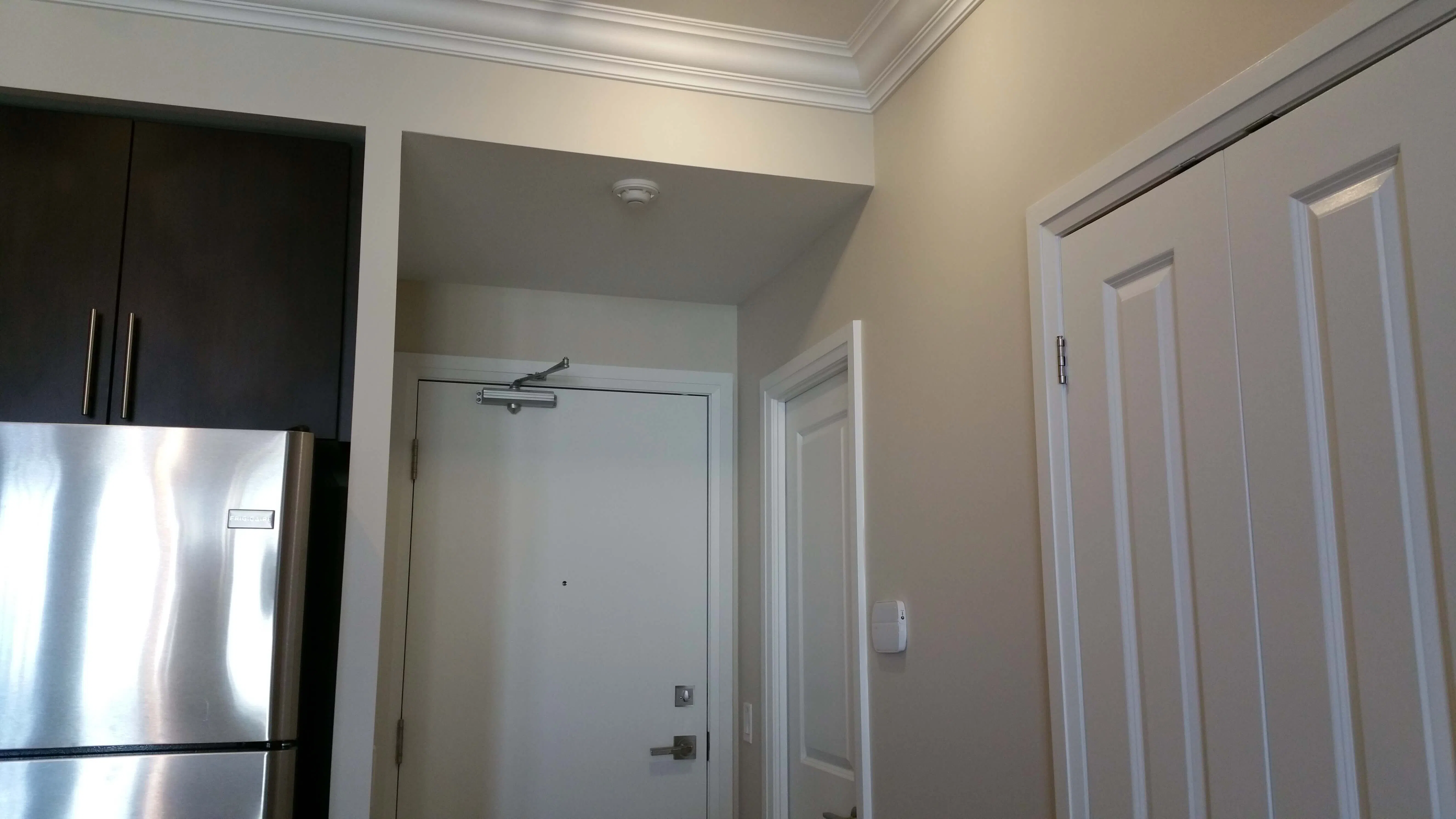
The price band is wide because it tracks the wallpaper's age and adhesive far more than the square footage. A 60-square-foot accent wall of modern pre-pasted vinyl can come down in two hours at the low end of the band. The same 60 square feet of 1985 wallpaper glued straight to unprimed drywall can take a full day, plus a skim coat, and lands at the top of the band. That is why a quote on wallpaper removal almost always includes an assessment step before a firm number, since we cannot see what is under the paper until we test a small section.
| Scope | Typical cost in 2026 |
|---|---|
| Per square foot | $1.50 to $4.00 |
| One accent wall (50 to 80 sq ft) | $300 to $1,200 |
| Full bedroom or dining room | $1,000 to $3,500 |
| Full unit, multiple rooms | $3,000 to $8,000+ |
| Skim-coat repair after damaged removal | Often included; sometimes itemised separately |
What that price covers is the labour: scoring, soaking, steaming if needed, stripping, scraping residual adhesive off the wall, washing the wall clean, and the skim-coating allowance for areas where the drywall face was damaged. It does not cover the paint job that follows; that is a separate line. We always quote them together so you see the whole number.
Why painting over wallpaper almost always fails (and the narrow case where it works)
Painting over wallpaper sounds like the obvious shortcut: skip a day or two of work, save the removal cost, and just roll over the existing surface. It almost never works, and the failure mode is predictable.
The first coat of water-based primer puts moisture into the wallpaper. That moisture reactivates the adhesive holding the paper to the wall. Within days to weeks, the seams between wallpaper strips start to lift and bubble, especially around windows, doors, and any corner where the paper was already under stress. Once seams start lifting, the only fix is to strip everything off and start over.
The narrow case where paint-over actually works
There is one case where paint-over actually works: the wallpaper has to be rock-solid, sealed, and the seams have to show no signs of lifting. Then you use a shellac-based or oil-based primer, never water-based. Water-based primers reactivate the adhesive (the failure mode above); solvent-based primers do not. The three products that work:
- Zinsser B-I-N, shellac-based, dries in 45 minutes, seals adhesive and prevents bleed-through. The most reliable choice. Strong odour during application, so ventilate aggressively.
- Zinsser Cover Stain, oil-based alternative, slower dry (about 2 hours), similar bond and seal performance.
- Zinsser Wallpaper Cover-Up, purpose-built for this exact use case, sized between B-I-N and a standard primer.
After the seal coat dries, the wall can be skim-coated to bury the texture and then painted normally. The total cost of this approach (sealer + skim + paint) often equals or exceeds the cost of just removing the wallpaper properly, which is why we still recommend removal for 95 percent of Toronto condos. Paint-over is the right answer only when the underlying drywall is so fragile (1980s unprimed drywall with the wallpaper bonded to the paper face) that removal would destroy the wall. In that narrow case, shellac primer + skim coat is the legitimate alternative.
The three-step removal method
Modern wallpaper removal is a three-step escalation: score, soak, and (if needed) steam. Each step adds time and energy, and we escalate only as the wallpaper resists. The order matters because each step is roughly twice as much work as the previous one.
Step 1: Score. A wallpaper scoring tool (rotating perforating wheels in a hand-held disc) lightly punctures the wallpaper face without cutting into the drywall. Scoring lets water and remover penetrate from the front through to the adhesive. We score in overlapping passes, covering the whole sheet. Pre-pasted vinyl often does not need this step; older paper with a sealed face always does.
Step 2: Soak. Apply a wallpaper-removal solution using a pump sprayer, focusing on the score lines. The professional choices, in escalating strength:
- DIY: 1 part white vinegar to 3 parts hot water, or equal parts fabric softener and warm water. Cheap and chemical-free; works on most modern pre-pasted vinyl.
- Commercial gel removers (DIF, Piranha). Stronger and slower-evaporating, hold their position on vertical surfaces longer.
- Hot water plus dish soap. Middle ground. The soap reduces surface tension so water penetrates faster than plain water.
The solution sits 15-20 minutes, long enough for the warm water to penetrate the adhesive and start releasing it. Test a corner with a plastic spatula (not a metal putty knife, metal gouges drywall); if the paper lifts cleanly, strip the rest. If it still resists, soak again or escalate to step three.
Step 3: Steam. An electric wallpaper steamer (Wagner W300, Earlex SS125) uses moist heat to soften the adhesive from behind the paper. Hold the steamer plate against a section for 30-60 seconds, then scrape with a wide putty knife. Steam works in roughly 80% of stubborn-wallpaper cases that resisted soaking; it's the workhorse for old-style heavy papers from the 1970s and 1980s, woodchip wallpaper, and anything that has been bonded to unprimed drywall for decades.
Two cautions on steam: (1) it puts considerable humidity into the room, so HVAC stays off and operable windows stay cracked during steaming, and (2) over-steaming a single area for more than 60 seconds can soften the drywall paper face beneath, which sets up the tear-the-face-off failure mode this article covers below. Move the steamer in a steady pattern, do not hover.
Some wallpaper still tears on the way off even with all three steps, which is why a skim-coat step after removal is part of most jobs.
What the wall looks like after removal
Once the paper is off, the wall almost always needs more work before primer. The most common conditions we find:
- Adhesive residue. A tacky, slightly cloudy film on the drywall face. We wash it off with a sponge and clean water, then let the wall dry overnight. Painting over residual adhesive causes flashing and uneven sheen.
- Torn drywall face. Patches where the paper bonded so tightly that the face of the drywall came off with it. These need skim-coating: a thin layer of joint compound feathered out, sanded smooth, and primed.
- Old water stains. Sometimes wallpaper hides water damage that was never repaired. These need a stain-blocking primer (oil or shellac) before any colour coat, and if the damage is recent the source has to be confirmed dry first.
- Builder-grade taped seams showing through. In 1980s buildings especially, the drywall finish underneath wallpaper is often rougher than what modern finishing standards would accept. A full-wall skim coat brings the surface up to a clean paint-ready condition.
A common rule of thumb: budget for a skim coat on at least 20 percent of the wall area after removal, more on older installations. We include the skim-coat allowance in the wallpaper removal quote, so the line item covers removal plus the surface repair that almost always follows. For more on the drywall side of that work, see drywall repair in a condo.
Why older Toronto condos are the hardest
The hardest wallpaper removal we do is on 1980s and early 1990s condos in midtown, Yorkville, North York, and parts of East York. The reason is a specific installation mistake: in that era, builders and decorators often applied wallpaper directly to unprimed drywall. Without a primer or sizing layer between the drywall paper face and the wallpaper adhesive, the adhesive bonds permanently to the drywall face. When we try to remove the wallpaper decades later, the only release point is between the drywall paper and the drywall gypsum core, which means the drywall face tears off with the wallpaper.
These jobs always need a full-wall skim coat, sometimes two coats, to bring the surface back to flat. The premium that lands them at the top of the cost band is the skim and sand stage, not the removal itself. If your condo wallpaper has been on the wall since the original construction in a 1980s building, expect a higher number than the per-square-foot rate suggests, and expect at least two days for the work.
What does not need removal
Not every wallpapered wall needs full removal. A few exceptions where we keep the wallpaper in place:
- Sound wallpaper as an accent wall the owner wants to keep. Obvious, but worth saying. We paint around it.
- Wallpaper murals or hand-applied panels in heritage buildings. Some early Yorkville buildings have original wallpaper that has cultural or design value; removing is a heritage conversation, not a painting one.
- Wallpaper used as a permanent texture base under skim. Rare, but on a few jobs we have used existing wallpaper as a base for a skim-coat finish where removal would damage the underlying surface more than the skim hides.
In all three cases we make the call after assessing the specific wall, not as a general policy. For most Toronto condos with dated wallpaper, removal is the right call.
Wallpaper removal is the prep job people underestimate
It looks like a shortcut to skip the removal stage, and it is the most common reason a paint job in a wallpapered condo fails within the first year. Done properly, removal takes one to three days per room, costs $1.50 to $4.00 per square foot, and produces a wall that paint will actually stick to and stay on. Done improperly, by painting over the wallpaper or by rushing the dry stage after removal, it produces a finish that lifts, bubbles, and peels before you have lived with it long enough to notice.
We will not quote a wallpaper job without assessing it first, because the adhesive history matters more than the square footage and we cannot guess what is behind the paper. The skim-coat allowance older jobs almost always need is built into the line item, not added at the end. Benjamin Moore over the prepped wall, 5-year warranty on the workmanship. To get an honest number on your wallpapered condo, send photos of the worst patch. For the bigger picture, our condo surface repair guide covers the prep stages and our complete condo painting guide covers the paint job that follows.
Chad Saygili is co-owner of Condo Painters Pro, a Toronto condo painting specialist. He has spent years painting condos across Toronto and the GTA, works exclusively with Benjamin Moore, and backs every job with a 5-year workmanship warranty.
MORE ABOUT OUR TEAM →